
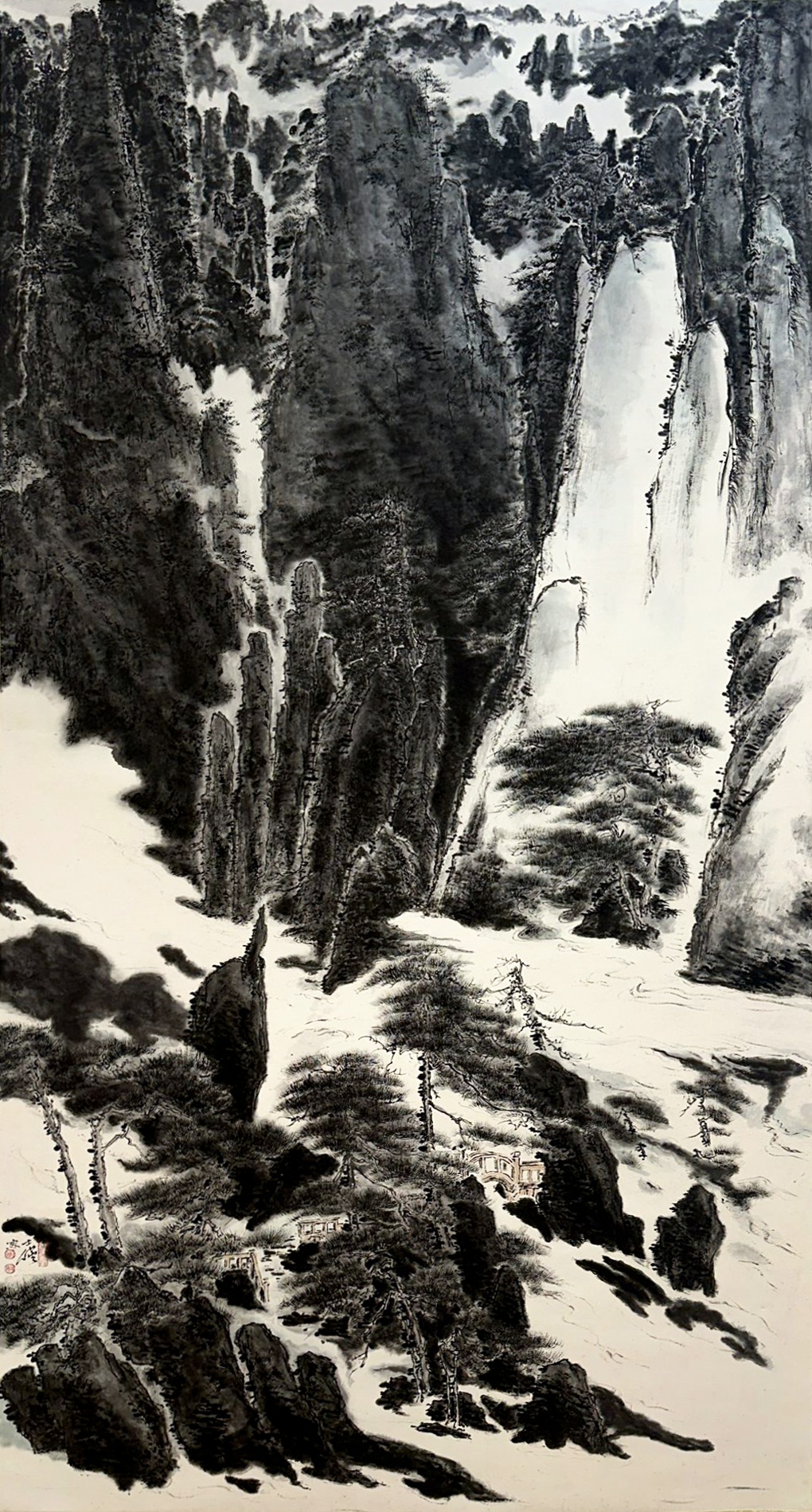
Huangshan is a collection of sketches of the mountain’s rocks and pine trees created during numerous on-site sessions. The artist lived on the mountain for more than forty days and climbed Huangshan eight times between 1982 and 2022. It was not until the past six years that he felt he had gained some insight.
This work creates a striking artistic tension by contrasting the “Black Mountain” with the “White Mountain.” Huangshan was historically known as “Yishan,” where “Yi” implies “darkness”; there was originally no concept of a “White Mountain.” However, to highlight the mountain forms and pine trees, the artist boldly painted the mountain white and used ink to create a backdrop, allowing the white mountain and white clouds to complement each other beautifully. In front of the cloud-shrouded mountains, a row of pine trees has been added as the foreground. This technique was developed through repeated experimentation following numerous failed attempts; looking back now, it stands as a relatively successful innovation.
《黄山》是山石与松树多次写生稿的合集。画家曾在山上住过四十余日,自1982年至2022年,先后登临黄山八次。直至近六年来,方觉略有心得。
此作以黑山、白山为对比,颇具艺术张力。黄山古名“黟山”,“黟”即黑多之意,本无“白山”之说。然为凸显山体与松树,画家大胆以白色绘山,复以墨色衬其后,使白山、白云相映成趣。云山之前,再添一行松树作为前景。此法乃经过多张失败之作后,反复摸索而出,今视之,当属较为成功的变法。
Huangshan is a collection of sketches of the mountain’s rocks and pine trees created during numerous on-site sessions. The artist lived on the mountain for more than forty days and climbed Huangshan eight times between 1982 and 2022. It was not until the past six years that he felt he had gained some insight.
This work creates a striking artistic tension by contrasting the “Black Mountain” with the “White Mountain.” Huangshan was historically known as “Yishan,” where “Yi” implies “darkness”; there was originally no concept of a “White Mountain.” However, to highlight the mountain forms and pine trees, the artist boldly painted the mountain white and used ink to create a backdrop, allowing the white mountain and white clouds to complement each other beautifully. In front of the cloud-shrouded mountains, a row of pine trees has been added as the foreground. This technique was developed through repeated experimentation following numerous failed attempts; looking back now, it stands as a relatively successful innovation.
《黄山》是山石与松树多次写生稿的合集。画家曾在山上住过四十余日,自1982年至2022年,先后登临黄山八次。直至近六年来,方觉略有心得。
此作以黑山、白山为对比,颇具艺术张力。黄山古名“黟山”,“黟”即黑多之意,本无“白山”之说。然为凸显山体与松树,画家大胆以白色绘山,复以墨色衬其后,使白山、白云相映成趣。云山之前,再添一行松树作为前景。此法乃经过多张失败之作后,反复摸索而出,今视之,当属较为成功的变法。